


02 December 2025
|
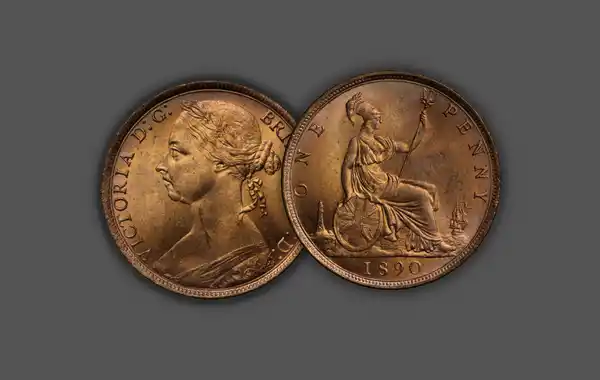
Discover the historical background to this interesting Victorian coin – issued between 1860 and 1894 – in this special coin guide, before reading our guide to prices paid online and at auction.
First minted in 1860, the ‘Bun Penny’ was a breakthrough in British coinage. The first type of bronze penny issued by the Royal Mint was. The first of a series that would last until decimalisation in 1971. Common in circulation in the United Kingdom until the 1960s.
The series is one of the most commonly collected coins by UK coin collectors. It comes in numerous varieties some of them exceptionally rare.
Despite the name 'coppers', Britain's small changes were bronze issues since 1860, though the old name persisted.
The switch from copper to less heavy bronze certainly reduced the weight of small changes in pockets and purses. It also answered the complaint that, when damp, copper coins stained fingers, even gloves. The copper also gave off a nose-wrinkling bad eggs smell offensive to middle-class Victorian sensibilities.
Rumoured coin error
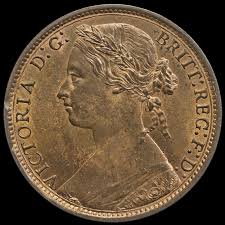
A delay in the new bronze issues reached all parts of the nation, and spawned newspaper stories that a fault had been discovered in the legend on obverses of the new money. With the abbreviation for BRITANNIA inscribed as BRITT, with two T’s in the phrase BRITT: REG.
Newspaper columns allowed expert numismatists to explain that the Latin word abbreviated by BRITT was in fact BRITANNIARUM. The complete phrase translated as QUEEN OF THE BRITISH ISLANDS.
In Latin inscriptions, abbreviated plurals have the final letter doubled, thus BRITT.
Station robbery
The Royal Mint made a decision to send barrels of coins to mainline railway stations where ticket office staff received instructions to give all change in new pennies and halfpennies.
At Sheffield local thieves broke into a station storeroom and trundled several barrels into their waiting getaway cart. The incident curtailed the Mint’s speedy circulation plan, and the thieves, who went on a small change spending spree around Sheffield shops, were soon in custody.
Suggested article: Your Guide to the Victorian Penny Lilac Stamp
Circulation of the new change gradually ousted all old coppers by 1871. We settled down to a century of bronze low denominations until decimalization swept the remnants into collections and dealers’ stocks by 1971.
Interest in them has grown steadily, especially in the penny, now known affectionately as the bun penny.
Why is it called a 'Bun Penny'?
The coin (94 parts copper, 4 parts zinc, 2 parts tin) presents us with a handsome portrait of Victoria, described in the contemporary press as an especially truthful likeness, without the faintest attempt at flattery, and with a regal and classical expression.
The bun penny gets its name from Queen Victoria's hairstyle, which is gathered together in a 'bun'. She wears a laurel wreath, and a scarf embroidered with a rose, thistle and shamrock. This portrait, introduced in 1860, became one of the most recognisable images of the young queen and marked a shift in the artistic style of British coinage as the country moved from copper to bronze issues.

Britannia on the reverse sits on a rock against a seascape, with a ship and a lighthouse to the left and right.
Experienced collectors seek out slight alterations to the portrait during the 34 years of production; and minor changes to the Britannia figure, the shield, the trident, the lighthouse and the ship. Several scarce or rare dates also offer challenges.
In addition, variations in die alignment, metal quality, and even the thickness of the planchets create a rich field of study for specialists. Some years exhibit distinctive errors or unusual patinas, adding further depth to the series. As a result, the bun penny remains a favourite among numismatists, combining historical interest, artistic variation, and rewarding complexity for those willing to explore its many nuances.
To learn more about all things Victorian Coins, subscribe to Stamp Collector inc Coin Collector today!