


27 April 2026
|
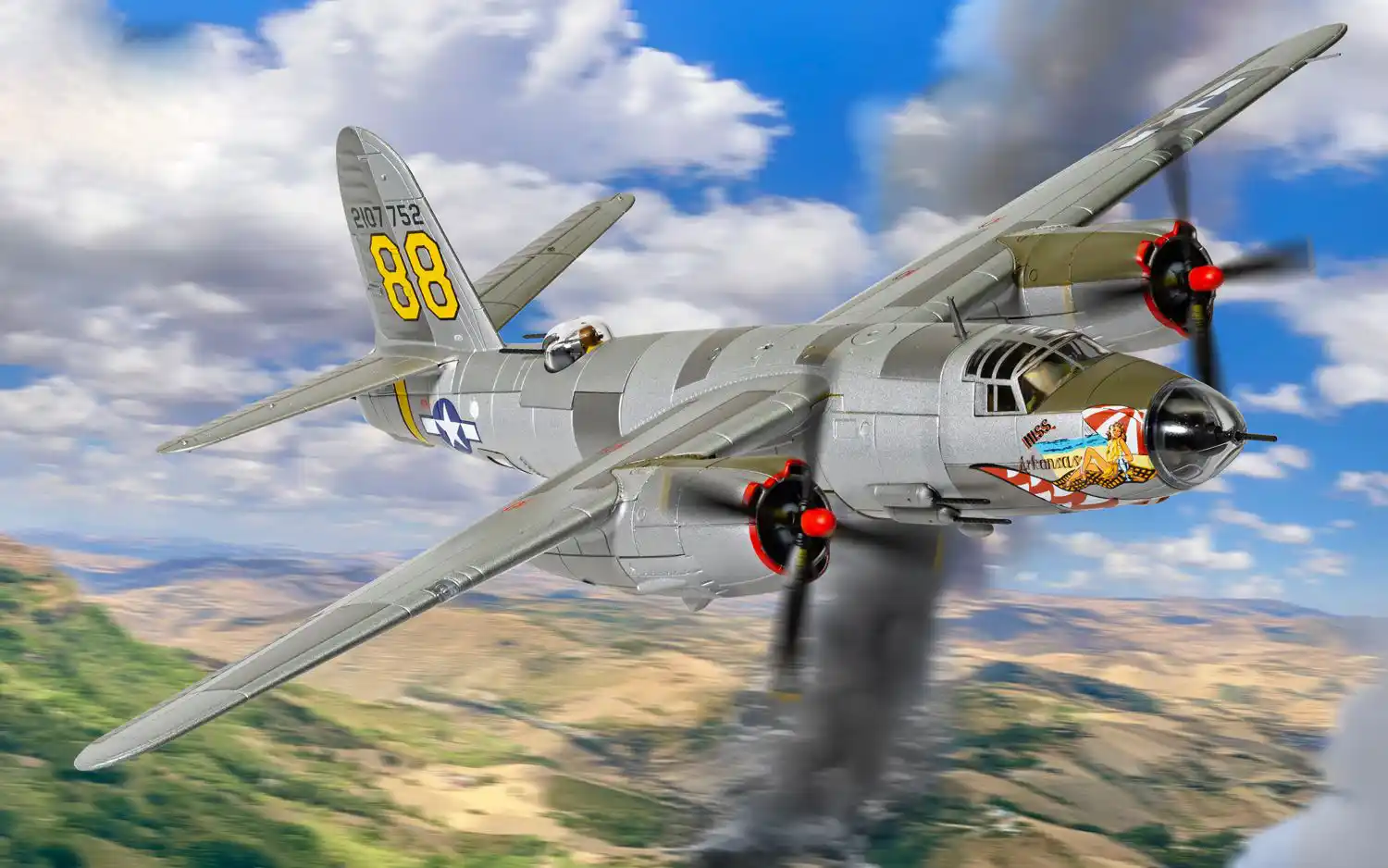
Corgi’s Aviation Archive range recently had a new tooling added to it with the launch of the 1:72 scale Martin B-26 Marauder.
Jarrod Cotter looks at the second release of a new tooling in the Corgi Aviation Archive range, the 1:72 scale Martin Marauder.
The first model launched was a D-Day themed example (AA29501), and now a second model has just been released, representing an aircraft of the Mediterranean Theatre.
The chosen identity is Martin B-26C-45-MO Marauder 42-107752 Miss Arkansas, as flown by Lt Leo A. Lampman of the 444th Bombardment Squadron, 320th Bombardment Group, 12th US Army Air Force, Decimomannu Airfield, Sardinia, circa summer 1944 (AA29502).
B-26 History
The B-26 initially attracted some unwanted nicknames, such as ‘Widow Maker’ and the ‘Flying Coffin’, because of the high number of aircrafts lost to crashes due to its tricky handling characteristics.
One of these was a high landing speed. It was a high-performance aircraft and was actually a delight to fly, but had some vices, which could cause problems for the unwary and inexperienced pilot. However, some design modifications and a revised training programme would soon improve the aircraft’s fortunes.
A high wing, highly advanced monoplane, the B-26 was powered by a pair of Pratt & Whitney R-2800 Double Wasp radial engines, the most powerful units available to the designers at that time.
These provided the Marauder with an impressive speed compared with contemporary aircraft. The highly advanced nature of the design saw the introduction of much newer technology, however, its relatively small wing and ever increasing operational weight requirements gave the B-26 an incredibly high wing loading.
This was the highest of any American aircraft during World War Two, and a figure which was some 40% higher than that of the similar North American B-25 Mitchell.
This high wing loading was something which made handling the Marauder extremely challenging for novice pilots to master and was a large reason why the aircraft suffered the high number of fatal accidents that it did during its introduction.
Jimmy Doolittle Steps In
This period proved so challenging that it almost brought about the aircraft’s premature withdrawal from service. Thankfully, the adoption of some design modifications and radical alterations to the flight training programme would result in a significant change of fortune for the B-26.
This ultimately transformed the reputation of the Marauder from something of an aviation nightmare, to one of the most celebrated and successful combat aircraft of the war.
It was done under the leadership of famous American pilot and national hero Jimmy Doolittle. He took it upon himself to lead something of a high-profile charm offensive for the Marauder, flying it extensively to discover where its problems lay and, significantly, how to overcome them.
He found the aircraft to be extremely capable. However, because it was rushed into service without first establishing a comprehensive pilot conversion programme, crews didn’t know what to expect when taking on this challenge.
With crews fearing the aircraft was flawed, damage to its reputation was by that stage almost irreparable.
This resulted in a situation where pilots were wary of flying the B-26 and, as a consequence, definitely didn’t want to be taking one of these ‘troublesome’ aircraft into combat.
Under the subsequent guidance of Doolittle, an Army Air Force film unit produced an instructional film to show pilots and ground crews alike how to handle the new aircraft correctly, and as he successfully demonstrated the aircraft at airfields all over the country, it soon began to allay the fears of uncertain crews.
As we now know, the B-26 Marauder would go on to establish an excellent operational reputation, particularly when used in the medium altitude bombing role.
It would ultimately go on to post the lowest combat loss ratio of any USAAF bomber used in World War Two.
Unit Citation
After some time, training in Florida, USA, the 444th Bomb Squadron was sent to England before completing the training programme.
They stayed for just over a month before being sent onwards with the rest of the 320th Bomb Group to North Africa and operations across the Mediterranean Theatre.
The Group was awarded a Distinguished Unit Citation for pressing home an attack against Axis troop concentrations at Fondi, in support of the 5th Army’s push towards Rome, despite coming under heavy enemy anti-aircraft fire.
The Model
With a fascinating story behind it, the B-26 Marauder has been of significant interest to modellers and enthusiasts over the years.
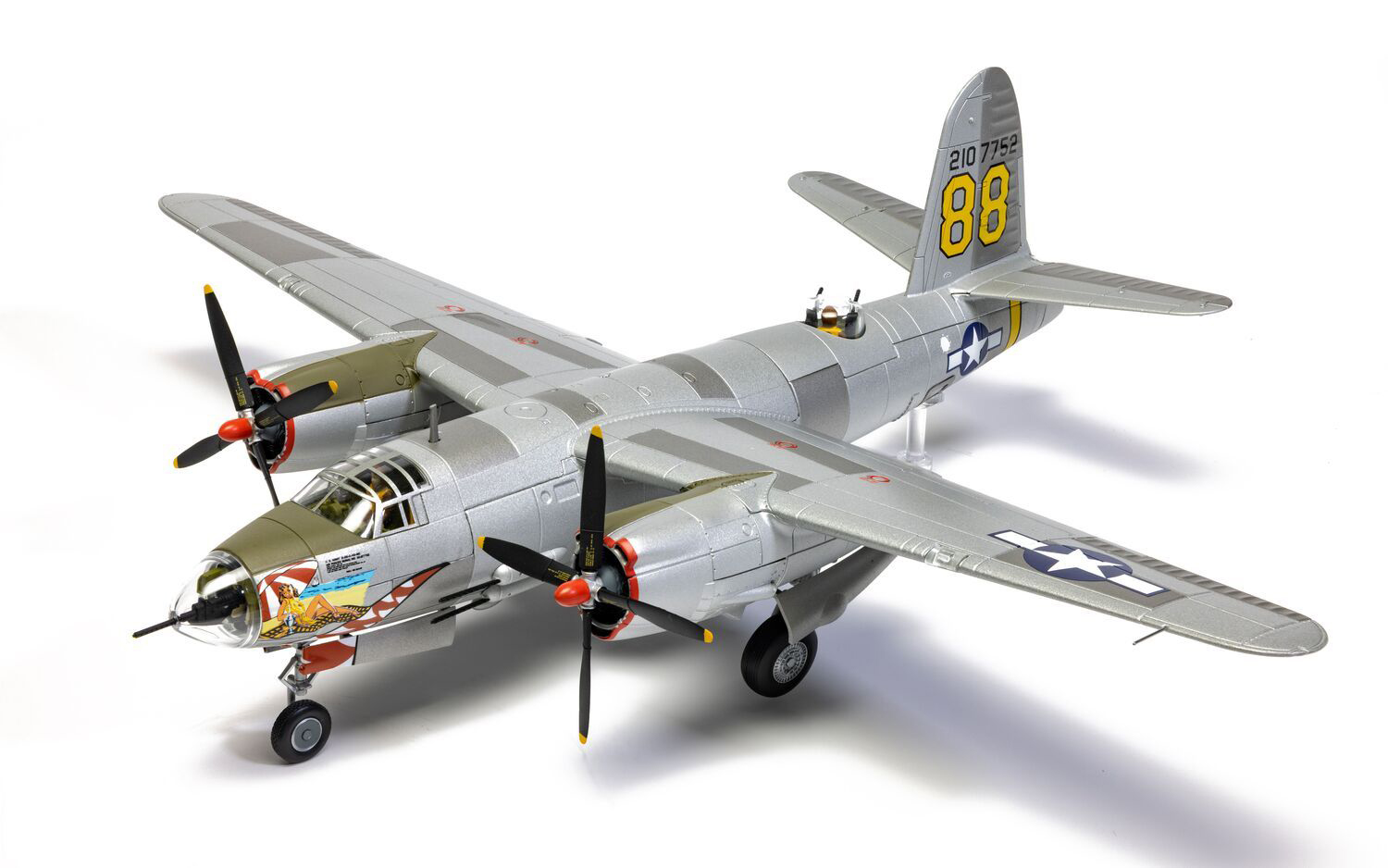
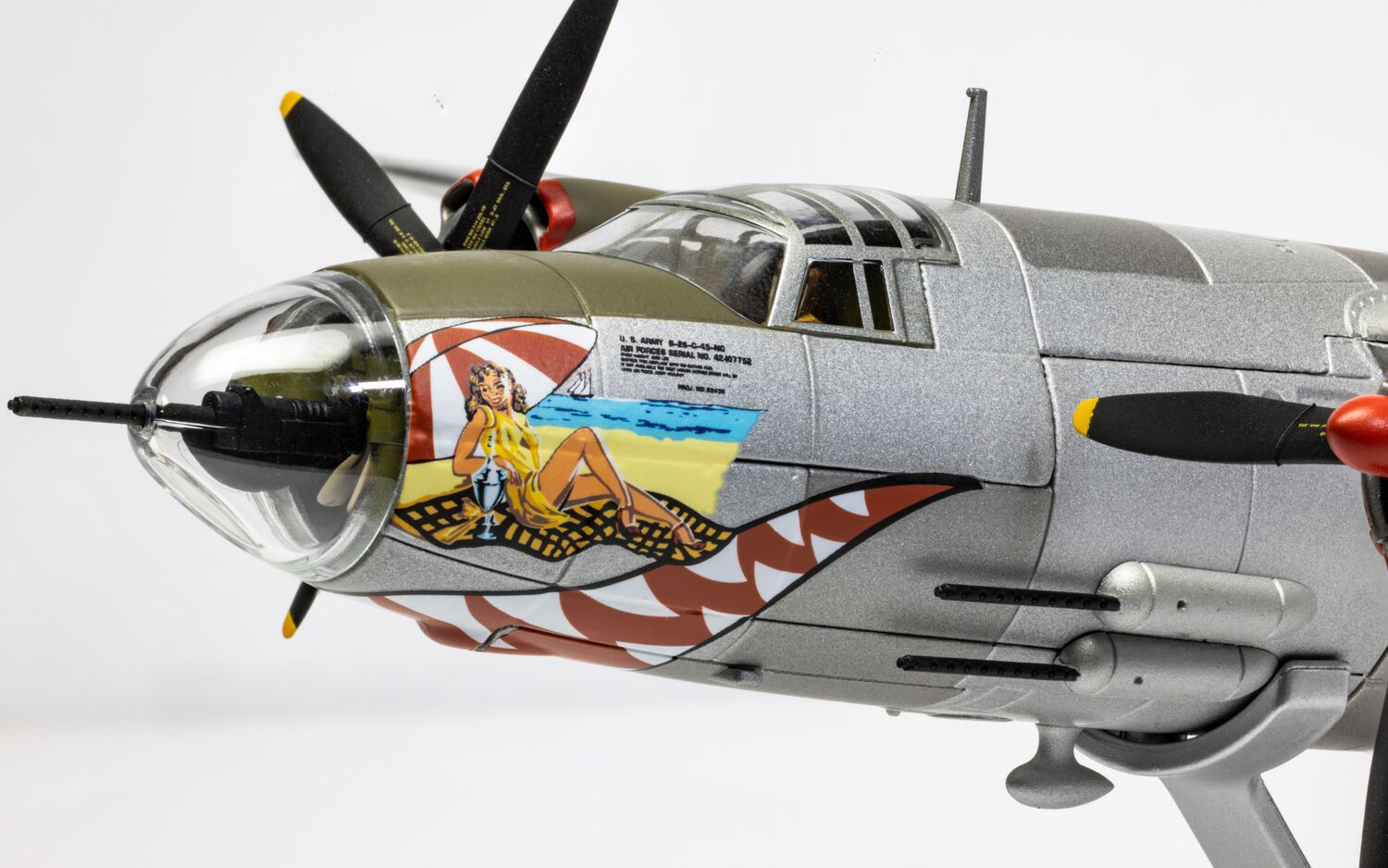
The particular aircraft chosen for this model was one of the most flamboyantly decorated of all the 444th BS Marauders, with a striking shark’s mouth on the underneath of its nose and beach belle artwork on both sides of the aircraft’s nose.
The model’s paintwork represents a bare metal multi-toned finish.
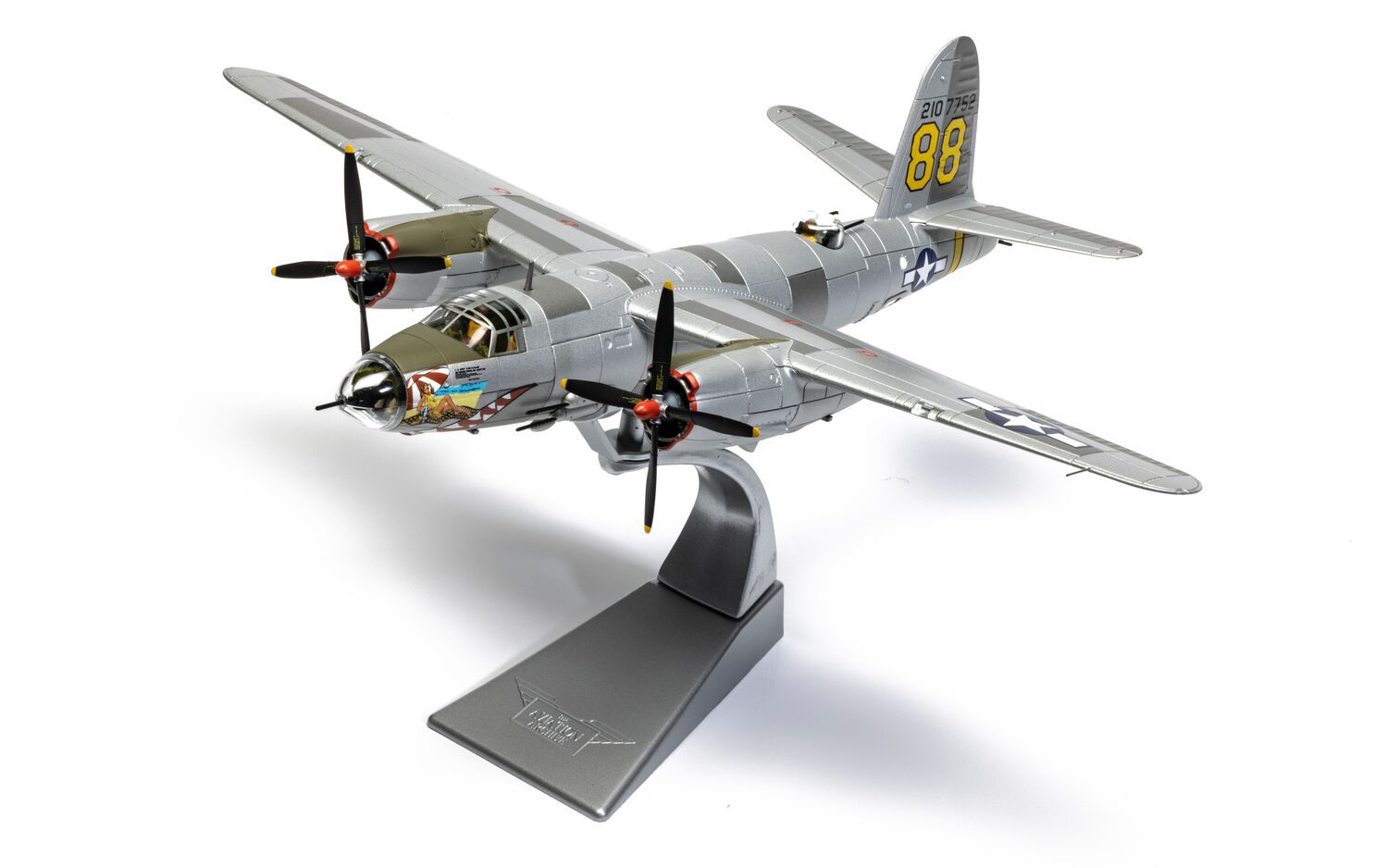
It has an open bomb bay option, revealing a bomb load, and parts to represent the undercarriage up or down. The propellers can rotate too. It has detailed crew figures and a cradle stand for display.
Also included is a clear plastic support to place under the tail of the aircraft if stood on a surface with the undercarriage down as the model is tail heavy.
This diecast model has a limited-edition run of only 1,500 units and has a length of 270mm, a height of 95mm and a wingspan of 300mm.
At the time of writing it was still available direct from Corgi priced at £129.99, or have a look at your favourite dealer’s website for availability.